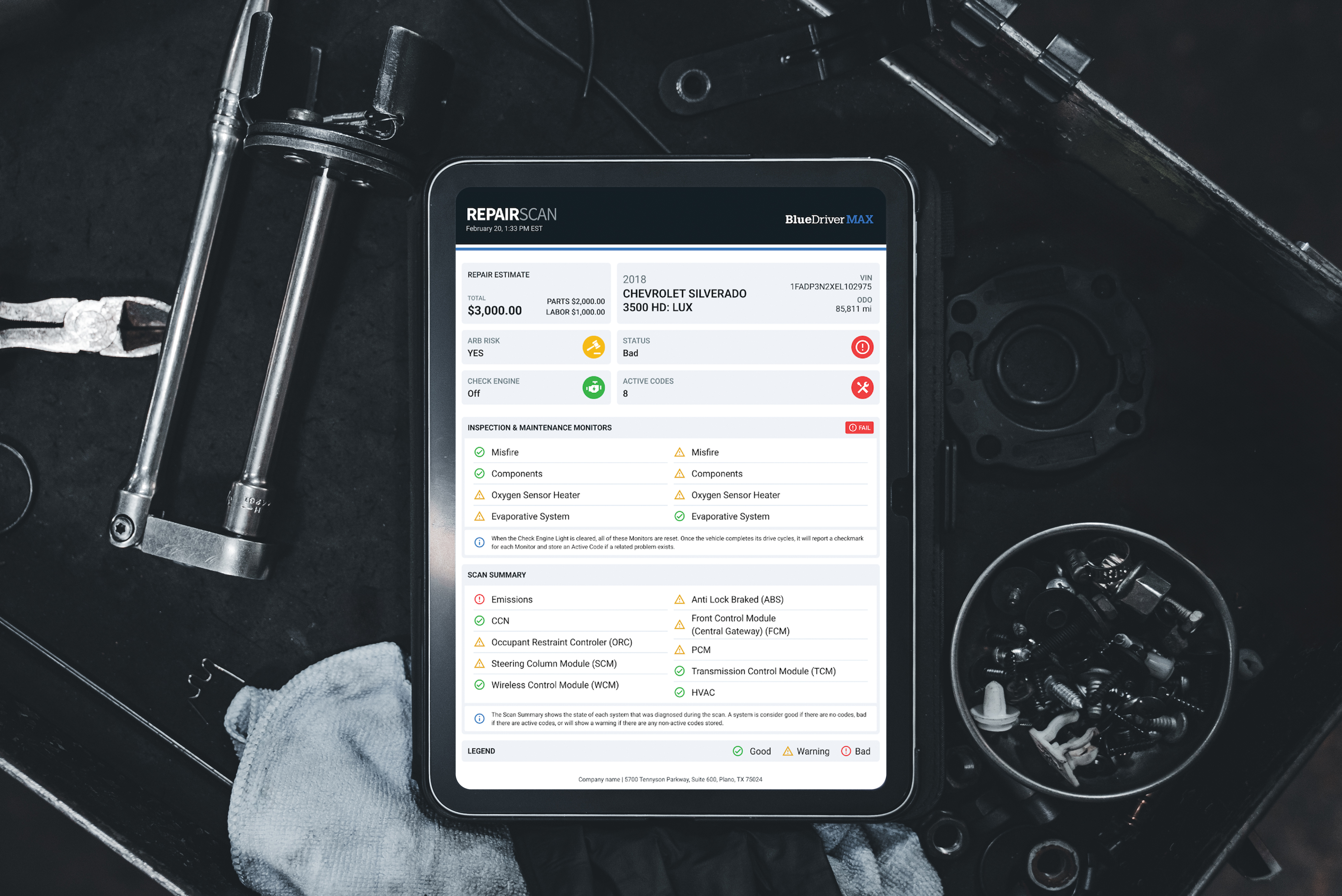
Today’s vehicles are complex systems with dozens of electronic modules monitoring performance, faults, and system behavior behind the scenes. Many of the issues that impact value, safety, and repair cost are not visible during a walkaround or basic inspection.
For dealerships, that creates risk.
A BlueDriver MAX diagnostic report provides a clearer picture—one based on real vehicle data. It helps dealerships understand the true mechanical condition of a vehicle, what issues exist, and what those issues may mean for pricing and reconditioning decisions.
Understanding how these reports work, and how to use them, is key to making more confident, data-driven decisions across appraisal, pricing, and recon.
Vehicle condition directly impacts profitability.
When issues go undetected during appraisal, they often show up later during reconditioning, adding unexpected cost, delaying time to lot, and eroding margins.
Visual inspections alone are no longer enough to prevent this. Many problems exist at the system level, stored as electronic data within the vehicle itself.
Diagnostic reports provide access to that data early in the process. Instead of relying on assumptions, dealerships can make decisions based on what the vehicle is actually reporting about its condition.
This shift, from observation to validation, is what makes diagnostic reporting essential in modern dealership operations.
A BlueDriver MAX diagnostic report is a professional, independent report generated from a vehicle scan.
It captures data from the vehicle’s onboard systems and presents it in a way that helps dealerships understand overall mechanical condition and potential issues.
Rather than showing raw data alone, the report translates system-level information into insights that can support real decisions, whether that’s pricing a vehicle, evaluating a trade-in, or planning reconditioning work.
It acts as a bridge between complex vehicle data and practical dealership workflows.
Pricing a vehicle accurately depends on understanding its true condition.
Without diagnostic validation, dealerships are often relying on partial information. A vehicle may appear clean on the surface while still carrying underlying issues that affect repair cost, reliability, or resale value.
Diagnostic reports provide a way to validate condition before those decisions are finalized.
Instead of relying on judgment alone, dealerships can support pricing with objective data—helping ensure that the price reflects the actual condition of the vehicle, not just what is visible.
A BlueDriver MAX diagnostic report surfaces key information that helps dealerships evaluate vehicle condition and repair needs.
This typically includes:
The goal is not just to identify that a problem exists, but to provide enough context to understand what that problem may mean operationally.
For dealerships, the value comes from how this data translates into decisions—what needs to be addressed, how significant the issue is, and what it may take to resolve.
Pricing conversations often come down to trust.
Customers want to understand why a vehicle is priced the way it is, especially in the used market where condition can vary widely.
A diagnostic report provides a way to support that conversation with data.
Instead of relying on explanation alone, dealerships can point to an independent report that reflects the vehicle’s actual condition. This helps:
The result is a shift from opinion-based pricing to data-backed validation.
Reconditioning is where time and cost can quickly add up.
When issues are discovered late in the process, they create delays, require additional coordination, and increase overall expense.
Diagnostic reports help move that discovery earlier, into the appraisal stage.
With visibility into vehicle condition upfront, dealerships can:
This early insight allows teams to build more accurate estimates and avoid unnecessary delays, improving overall efficiency and turnaround.
One of the biggest challenges in used vehicle operations is uncertainty.
Hidden issues can significantly impact profitability if they are not identified before a deal is finalized or pricing is set.
Diagnostic reports reduce that risk by uncovering problems that may not be visible during inspection.
This helps dealerships:
Catching issues early allows teams to adjust pricing, plan repairs, or reconsider the deal altogether—before those costs affect the bottom line.
The value of a diagnostic report comes from how it fits into the full dealership process.
At appraisal
A scan provides immediate visibility into vehicle condition, helping identify hidden issues before committing to a value.
Before pricing
The report helps align pricing with actual condition, ensuring that the vehicle is priced appropriately based on its mechanical state.
Before reconditioning
Teams can use the report to plan repairs, coordinate vendors, and prepare parts in advance.
During the sale
The report can be used to support pricing conversations, providing customers with a clear, data-backed explanation of vehicle condition.
By connecting these steps, diagnostic reporting becomes part of a more consistent and efficient workflow.
Trust plays a major role in vehicle sales.
When pricing is supported by clear, independent data, it removes much of the subjectivity from the conversation.
Diagnostic reports help dealerships demonstrate transparency by showing exactly what the vehicle is reporting about its condition.
This builds confidence for customers and reinforces the credibility of the pricing strategy.
A BlueDriver MAX diagnostic report is more than a snapshot of vehicle data.
It is a tool that helps dealerships connect condition data to real decisions—across appraisal, pricing, and reconditioning.
By providing early visibility into mechanical condition and repair needs, it allows teams to move faster, plan more effectively, and reduce uncertainty throughout the process.
In an environment where margins are tight and timelines matter, that level of clarity can make a meaningful difference.
Every vehicle has information that is not immediately visible.
Diagnostic reporting brings that information forward, early enough to act on it.
With the right data at the right time, dealerships can price more accurately, plan reconditioning more effectively, and reduce the risk of unexpected costs.
That leads to better decisions, stronger margins, and a more consistent process from appraisal to sale.
See how BlueDriver MAX diagnostic reports help you validate vehicle condition, justify pricing, and plan reconditioning with confidence.
Ready to see how BlueDriver MAX can transform your business? Reach out to us to get started.

